


Local Partnerships & Expertise Support District Savings & Energy Stewardship
A rural Iowa school district might seem to be an unlikely location for interesting work on energy conservation and clean energy production. Yet, I’m going to tell you a good-news story that illustrates how a local school district (Decorah) can leverage community expertise (the Winneshiek Energy District and related partners) and the power of passionate people (a group of fantastic students) to create a long-term project that will reduce fossil fuel use and save the school money.
This story shows how change moves forward through involvement from a diversity of parties – advocates and administrators, experts and educators, conveners and community leaders.
Rural School Districts: The Constraints
Iowa rural schools face a notoriously difficult financial situation. Long-term declining student enrollment coupled with nearly twenty years of low state aid for schools has caused hundreds of rural districts around Iowa to cut their operations and programs. While not in as dire straits as some districts, Decorah faces similar financial pressures as others around the state.
Any work to reduce energy consumption or increase clean energy production must accept the reality that money is extremely tight and there are many worthy causes competing for sparse district funds.
The Spark: Student Advocacy
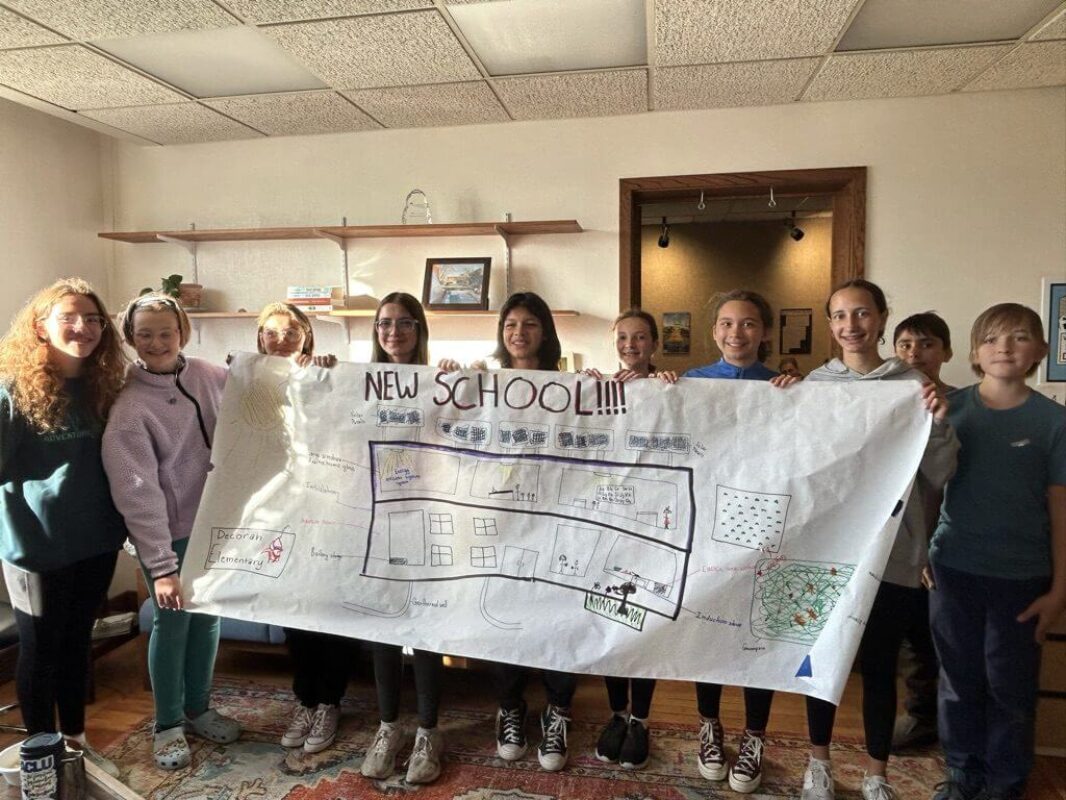
The spark for this initiative came about three years ago from a group of middle school students. This group approached Scott Boylen, 6th-grade science teacher, to form a Climate Action after-school club. Volunteering his time, Mr. Boylen met with students on a variety of projects, including a student-led project to research net-zero school building.
Concerned about climate change and wanting to do something positive locally, this group of students researched, contacted, organized, wrote, and presented information about net zero schools to the school district’s new school Facility Committee and to local organizations around town, advocating for the creation of a net zero school and whatever else could be done to reduce the use of fossil fuels in the school district.
The presentation caught the eye of Cindy Goodner, president of the Decorah School Board, who responded to the student advocacy: “The information you shared was heard by that room of community leaders, and the poise, confidence, and the sense of urgency that you all expressed made a difference.”
As a former teacher, I taught just down the hall from Mr. Boylen when the Climate Action group began meeting. I noticed his after school work and once asked him about the time and energy he volunteered. His reply: “The students GIVE me energy. It’s a privilege to work with them.”
Making Rooftops “Solar Ready” and a new Power Purchase Agreement (PPA)
One of the projects that came directly from the work the students presented was an investigation of how the district, with few funds to deploy, could begin to generate solar power to decrease emissions and see long-term energy savings.
As a result of that work, the DCSD agreed to a Power Purchase Agreement with Perry Novack Electric to build a 120kw solar panel system at the bus garage and Central Office in Freeport, Iowa. According to the PV Watts calculator, an array of this size could reasonably generate 160,000 kwh annually, saving the school district money and the planet additional atmospheric carbon. Furthermore, as the agreement matures, the school district can purchase the system for additional energy and cost savings.
The new elementary school (under construction now) was designed so rooftop solar could be added later. Public school finance is complicated and rule-bound. There are several “silos” of money that can only be spent on specified types of projects. Much of the Physical Plant and Equipment Levy (PPEL) that could be used to purchase solar panels has been allocated to the new school construction project, but as that project gets completed the PPEL funds could be used for other infrastructure improvement, including improvements that can lower energy inputs (building efficiencies and retrofitting) and increase renewable energy output (solar arrays.)
As buildings get re-roofed, these spaces become places the district could place additional solar arrays in the future, either through additional PPAs or through direct purchase of solar panels through the PPEL funding mechanism.
As school board member Carole Sand noted recently: every dollar that doesn’t go to pay for utilities can be used for educating our children.
Ad Hoc Energy Committee to Create a Long-term Energy Plan
Another outcome of the student advocacy was the creation of a new Energy School Board policy. That sounds kind of dry and boring, but the school board was so impressed with the work the students had done they wanted to make sure that they could continue the work into the future. And policy is how that happens.
The School board asked Dr. Tim Cronin, school superintendent, to draft a new policy that would help it reduce fossil fuel use and save money. After looking through school board policies around the state, I can confidently say there are few districts that have policies like Decorah’s that help their schools identify planned reductions in fossil fuel use.
At their August meeting, the DCSD school board tasked an ad hoc Energy Committee to meet and return recommendations for how the district can save energy and money.
The Winneshiek Energy District is a key local player on that committee, as is Reilly Loveland from the New Building Institute in Oregon. Reilly has lots of experience working with school districts to design and build new buildings and to retrofit existing buildings. And, it was Decorah Middle School students who first contacted her, built a relationship with her, and got her interested in working with us here in Decorah. WED’s Executive Director Kristin Eggen has helped facilitate those conversations and kept things organized and progressing forward.
Composed of Dr. Tim Cronin (school Superintendent), school board members Carole Sand and Lilly Jensen, as well as various school staff, Reilly, and members of the Winneshiek Energy District led by Kristin Eggen, the Energy Committee has set a goal of producing an Energy Plan the school district can review and vote on it by March 2027.
Currently, the committee is gathering baseline energy use data, setting reduction goals, and creating inventories of building systems. Soon, the committee will pull together energy audit data and create some menus of choices including cost and return on investment information for the district’s use.
Winneshiek Energy District – a valued community partner
The Winneshiek Energy District is a key player in this process, bringing together expertise from the clean energy world, helping to organize meetings, and providing volunteer time to help the school district move forward when financial and human resources are stretched tight.
As a member of the Clean Energy Districts of Iowa (CEDI), WED connected the district to pro-bono energy engineering expertise that will provide school facility operators with energy analysis and tangible recommendations for future equipment.
As school board member Lilly Jensen noted at a recent school board meeting: “It’s hard to imagine how we could do this without the support of the Energy District.” Adding later, “It (the ad hoc committee structure) allows us to leverage the passion and expertise of members of our community to increase the work the board can do.”
While the WED offers energy efficiency services and programs– the Commercial Audit+ program is a good example of that – some of the work the WED does is built on the Soil Conservation District model that was its inception: being a local source of knowledge, encouragement, and relationship building that are often necessary to begin large, long-term, complex changes.
Local donations support WED’s local work. Our work with the Decorah School District is just one recent example of how those donations pay off.
About the author:
Steve Peterson is a current Winneshiek Energy District board member and a retired teacher. In his 20+ year career in Decorah, he taught K-6, finishing his last eight years in fifth-grade science just down the hall from the incomparable Mr. Boylen.

Don’t miss these

Data Center Moratorium is a WIN for Clean Energy in Winneshiek County
On Monday, September 28, Winneshiek County passed a year-long data center moratorium. The decision came at the recommendation of Winneshiek County Planning and Zoning Commission …

Your Fall Home Energy Checklist
As autumn brings crisp air and cooler evenings, now is an ideal time to prep your home for the upcoming heating season. A few simple …
A Fresher Approach to Drying Clothes
When we talk about residential energy efficiency, heating, cooling and insulation usually come to mind. Yet sitting in every home’s utility room is one of …